
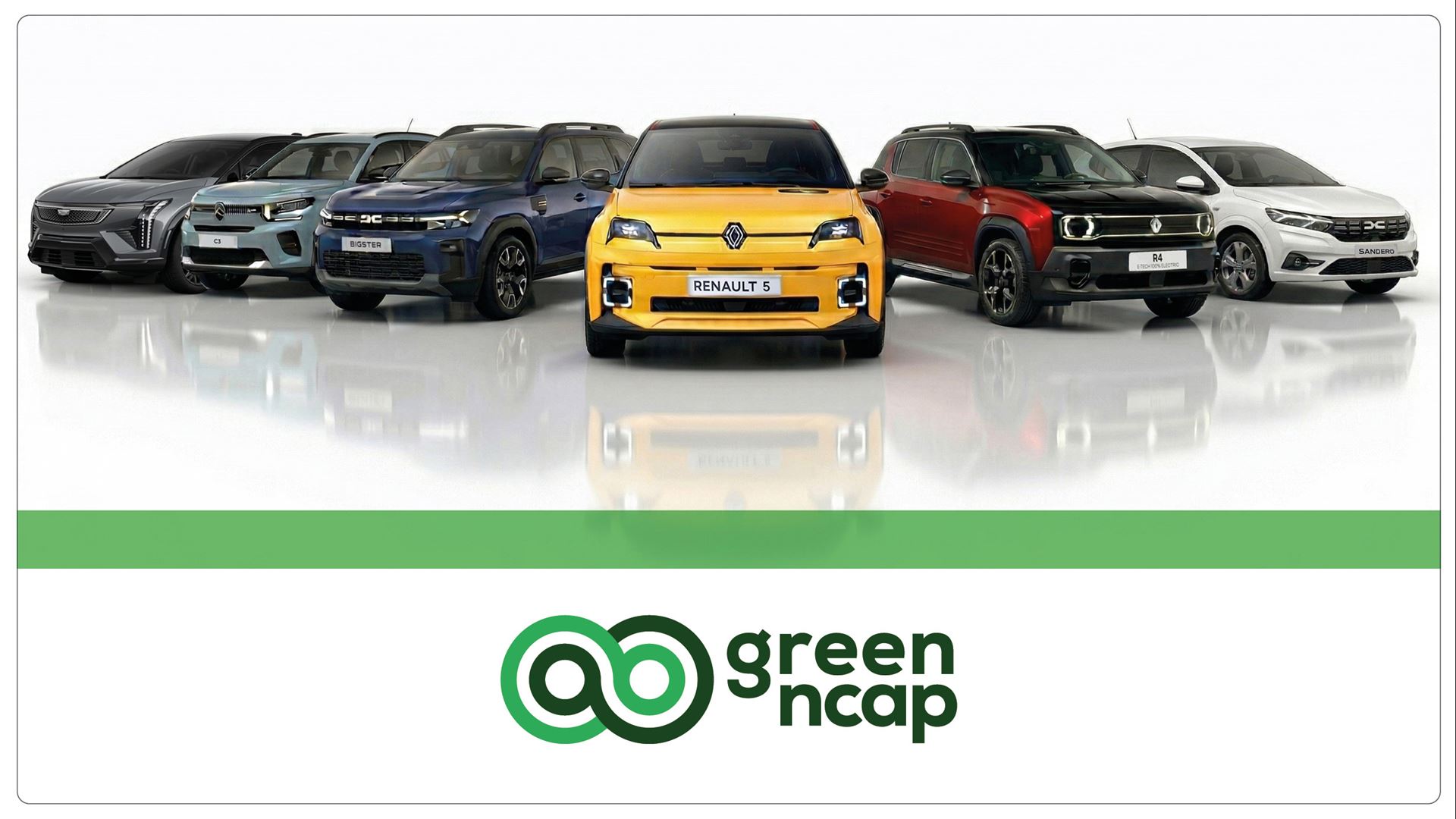
- Renault 4 E-Tech and Renault 5 E-Tech awarded maximum five-star rating by Green NCAP
- Green NCAP rating considers everything from raw materials, manufacturing and distribution to operating use and driving performance, and even end-of-life recycling
- Comparison between an electric and a hybrid large SUV helps consumers choose the most sustainable SUV for their needs
- Testing of the Dacia Sandero, Europe’s best-selling car, shows there is room for improvement when it comes to environmental impact
- Dr. Aleksandar Damyanov, Technical Manager, Green NCAP, available for media interviews
The original Renault 4 and Renault 5 delivered charm, practicality and affordability. As a result, both models proved popular with drivers throughout the oil crises of the 1970s. Now the reborn Renault 4 E-Tech and Renault 5 E-Tech, reinvented for the electrified age, look set to repeat that success after achieving a five-star Green NCAP sustainability rating.
The strong Green NCAP results build on recent Euro NCAP safety ratings and highlight the cars’ environmental impact, energy efficiency, and hence running costs – factors that remain relevant for motorists across Europe and the UK amid rising fuel prices.
Green NCAP’s latest tests also reveal how the Dacia Bigster, a hybrid-powered SUV, matches the sustainability rating of the fully electric and similarly sized Cadillac Optiq. Findings follow total life cycle-based assessments of both family-oriented large SUVs across Clean Air, Energy Efficiency, and Greenhouse Gas Emissions.
The final two ratings released by Green NCAP today are for the Citroën C3 and Dacia Sandero. The latter has been Europe’s best-selling car for the past two years, but Green NCAP tests show consumers that there are more environmentally sustainable superminis on offer in the small car segment.
Renault reinvents popular models for the electric age
Against a backdrop of geopolitical instability, drivers of combustion cars face rising costs at fuel stations. It means many are weighing up switching from a petrol or diesel model to one with a different powertrain. But the choice is extensive: mild hybrid, full hybrid, plug-in hybrid, range extender, and pure electric vehicles are all competing for consumers’ hard-earned money.
Determining which vehicle delivers the greenest solution, offers affordable running costs, is practical to live with, and does not compromise on safety is a complex task. This is where Green NCAP, and partner organisation Euro NCAP, help consumers. Their extensive testing means drivers can make informed choices when changing their car.
The standout results in the latest Green NCAP tests belong to the Renault 5 and the Renault 4, both of which performed exceptionally well to achieve maximum five-star ratings. The pair demonstrate a low environmental impact alongside impressive results in Driving Experience assessments. This follows on from good results achieved in Euro NCAP safety testing and suggests both models should appeal to consumers who value safety and environmental performance.
Highlights from Green NCAP testing show the Renault 5 achieved a high 9.1/10 Clean Air Index and 9.3/10 for Energy Efficiency, while the Renault 4 reached a 9.4/10 Clean Air Index, due to properties that lead to less tyre abrasion.
Even more impressive is the cars’ performance in the Greenhouse Gas assessment, where they achieve the maximum score available. Compared with many other vehicles, both Renaults demonstrate a significantly lower impact on the climate when analysed across production and battery manufacturing, lifetime energy use and end-of-life recycling.
Both cars also offer bidirectional charging capabilities, meaning they can be used to power external devices, home appliances or feed energy back to the grid (where permitted). And when it comes to analysing their real-world behaviour, the Renault 4 and Renault 5 perform well in charging, cabin heating and actual energy consumption.
Hybrid-powered SUVs can close the gap to electric models for environmental impact
A compelling result emerged when comparing the Cadillac Optiq and Dacia Bigster test results. Both are large SUVs offering seating for five and generous luggage space, features that make them well-suited to growing families. However, what was interesting for Green NCAP’s experts was that the hybrid-petrol-powered Bigster and the pure-electric Optiq had almost the same environmental impact overall.
For drivers who regularly undertake long journeys, a hybrid is attractive because it doesn’t require potentially time-consuming recharging along the way. In the case of the Optiq, its significant 80kWh battery, large size and heavy mass of nearly 2.4 tonnes take a toll on efficiency, especially in cold winter conditions and on the highway, impacting its range. And when you do need to make a pitstop and fast-charge the battery, the Optiq’s DC charging performance is noticeably slower than that of other electric SUVs of a similar size, meaning drivers could be waiting almost 40 minutes to charge from 10% to 80%, even under ideal conditions.
Overall, the Optiq was awarded three-and-a-half stars, with a Green NCAP score of 67 per cent. The Dacia Bigster was also awarded three-and-a-half stars, with a score of 63 per cent. The Bigster's hybrid system makes excellent use of its electric power reserves, resulting in impressive fuel consumption as low as 4.8 L/100 km (59mpg) in city driving (in warm weather conditions).
Europe’s best-selling car outsmarted by hybrid-powered rival
Testing of the Citroën C3 110 hybrid petrol, which uses a 48-volt mild-hybrid system to lend a hand to the petrol engine, shows that it makes small but appreciable gains in most areas over the popular Sandero TCE 100 petrol. Reaching a high three-and-a-half star rating, with a score of 62 per cent, the hybrid C3 benefits from a low vehicle weight of just 1,273 kg, which reduces the environmental impact of production and mitigates tyre abrasion. While its greenhouse gas result is moderate due to the use of a combustion engine, its efficiency in warm weather testing stands out, at 4.7 l/100 km (60 mpg).
In contrast to these high performers, the Dacia Sandero highlights the risks of assuming a smaller car is inherently greener. At 59%, despite being a light and affordable supermini, the Sandero was unable to surpass the three-star threshold. While its low mass helps reduce production energy, its unremarkable fuel consumption (5.7 l/100km, 50 mpg in warm weather driving) could make it more expensive to run, while weaker pollutant control during cold starts limits its sustainability score. Consumers who are drawn to the Sandero should note that a hybrid model is due to be released later this year.
Green NCAP offers drivers a trusted, independent view of a car’s true environmental impact, highlighting real-world energy consumption and giving drivers useful insight, especially at a time when fuel prices are rising.
Renault should be congratulated for making desirable electric cars that are practical, efficient and affordable. The new 4 and 5 E-Tech deliver good scores in Green NCAP’s sustainability rating and an impressive driving experience – an interesting choice for consumers.
And as more car makers and drivers pivot toward hybrid-powered cars, it has been interesting for Green NCAP to show how two similarly large SUVs – one hybrid, the other electric – can have broadly the same environmental impact, but with very different practical constraints on drivers who undertake long journeys or have different expectations about luxury.— Dr. Aleksandar Damyanov, Technical Manager Green NCAP