
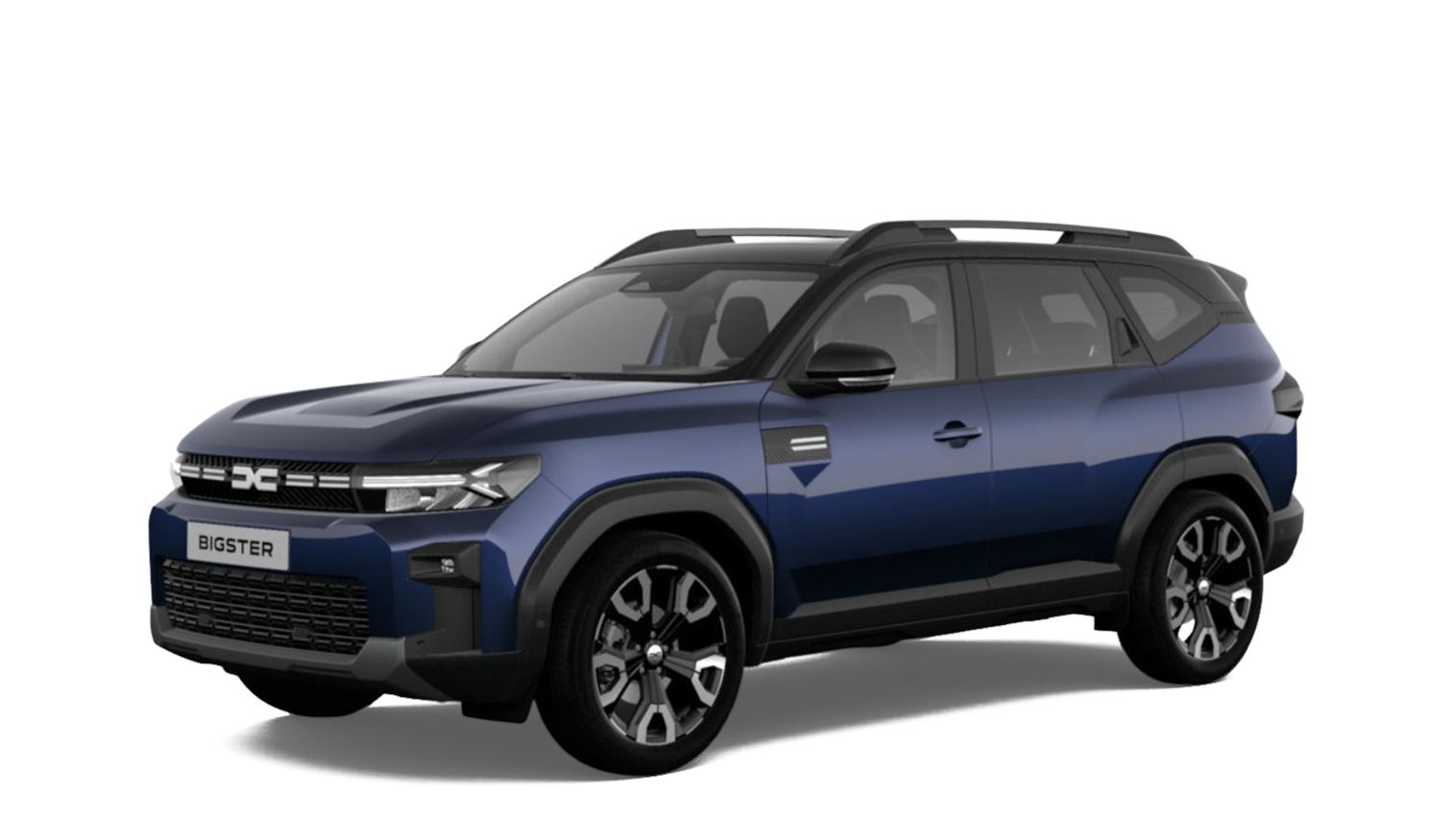
Dacia Bigster
Journey hybrid FWD automatic
Sustainability Rating: 3½ stars
Our verdict:
Tested here is Dacia's new large SUV – the Bigster, in its full hybrid version. Despite its name, the vehicle is surprisingly light and puts only 1,436 kg on the scale. Its operating strategy makes good use of the 280 V electric system, resulting in creditable consumption values. The hybrid Bigster surprises with a high rating score, achieved through robust emissions control, an efficient powertrain and reduced resources usage.
- The Bigster hybrid cuts exhaust pollutants very effectively in all tests, scores near maximum points for tyre abrasion and uses hybridisation to reduce brake wear. Production related emissions slightly lower the Clean Air score.
- Delivers strong energy efficiency results with low production energy demand and solid fuel consumption: under 5 l/100 km in warm tests, about 7.2–7.3 l/100 km in cold and highway cycles, and 5.1/4.8 l/100 km in mixed and city driving.
- Benefits from low fuel use but still emits significant CO2 from combustion. Lifecycle emissions total 226 g CO2-eq./km, with 130 g CO2-eq./km coming directly from the exhaust.
Driving Experience
Our comments:
Compared to conventional vehicles, which are only evaluated in the 'Consumption and Range' section, the Driving Experience assessment of full hybrid vehicles also includes the 'Cold Winter Performance' Category.
- The real-world consumption estimations place the expected Bigster performance generally in the 'good' range for warm weather trips and in 'adequate' for cold winter drives. The car is equipped with a PTC heater, but as heating in cold weather can require additional power, the combustion engine might need to be switched on in phases where it would usually be inactive and thus the consumption figures in cold weather increase.
- The cabin heat supply of a combustion engine vehicle is much slower compared to an electric vehicle, but the Bigster is additionally equipped with an electric heater, which should have helped reach comfortable temperatures quickly. However, the heating up remains slow and overall performance is evaluated as poor. The thermal insulation of the cabin is adequate so once the desired cabin temperature is reached it should be maintained more easily.
See datasheet for more details.