
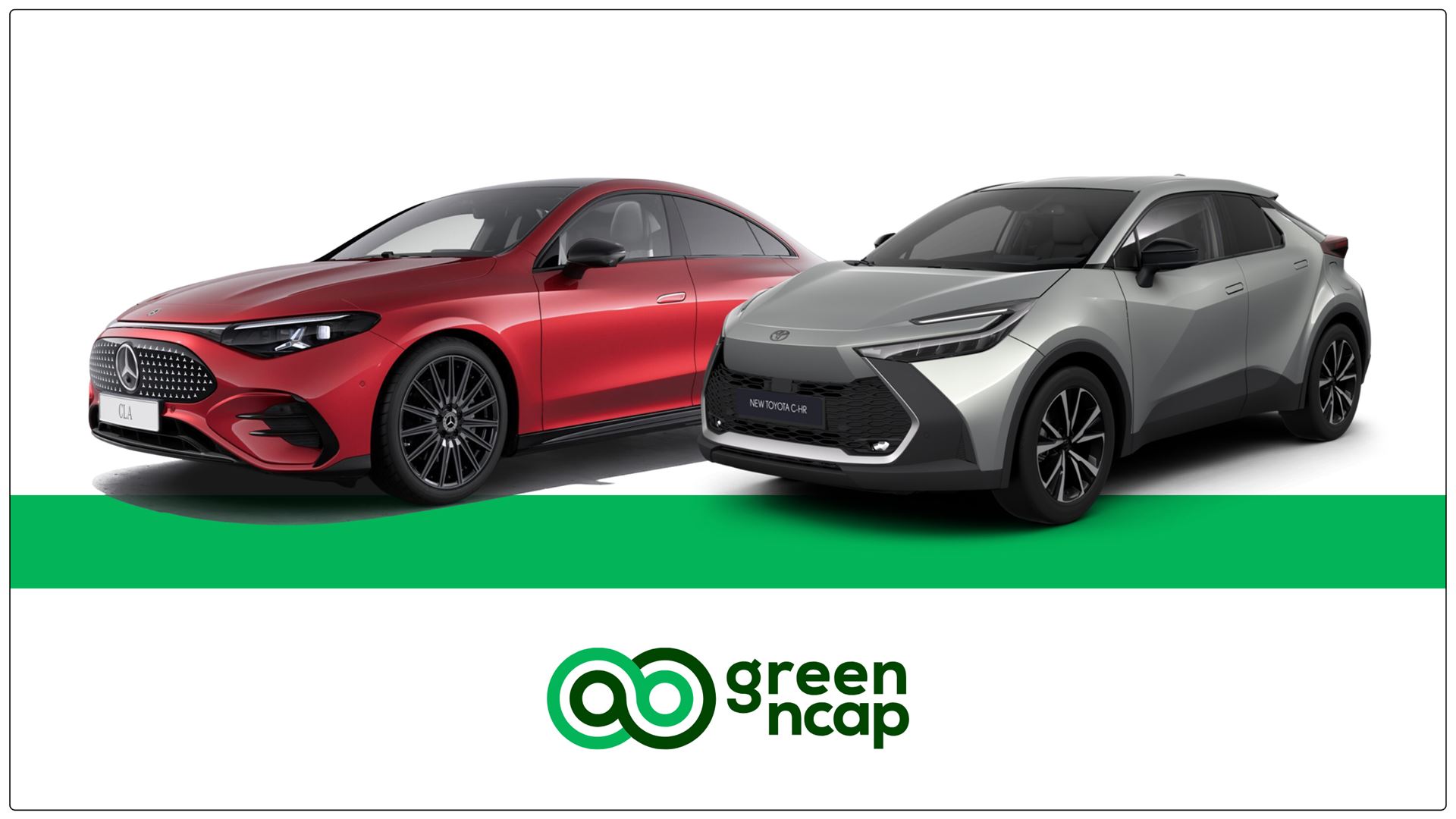
- Mercedes-Benz CLA EQ 250+ shows that a five-star environmental performance is not reserved for compact electric cars with small batteries
- No more range anxiety: boasting an impressive real-world driving range and rapid fast charging, the CLA EQ 250+ can handle long-distance driving
- Five-star sustainability rating complements CLA’s Euro NCAP five-star safety rating and Best Performer award in Best in Class 2025
- Toyota C-HR hybrid scores a commendable three-and-a-half stars
- MG HS and MINI Cooper C also tested and rated by Green NCAP
- Media assets can be downloaded here
LEUVEN, BELGIUM – Testing performed by Green NCAP shows that the latest generation of electric car can banish range anxiety while achieving a five-star sustainability rating.
As the sustainability ratings partner of Euro NCAP, Green NCAP assessed four new cars, spanning electric, hybrid, and petrol powertrains. The leading sustainability rating was achieved by the electric Mercedes-Benz CLA EQ 250+, which shatters the misconception that low energy consumption can only be achieved by small, light cars.
The CLA EQ 250+ achieved a five-star Green NCAP sustainability rating with an overall score of 91 per cent, combining long-distance usability, rapid charging, and a low lifecycle carbon footprint with excellent energy consumption.
This mid-sized premium coupé’s environmental credentials are even more impressive given its excellent driving range.
Experts from Green NCAP also assessed the MG HS, MINI Cooper C and Toyota C-HR, from the popular hatchback and SUV classes. The results underline the widening sustainability gap between the strongest electric and hybrid performers and conventional petrol-powered models.
Mercedes-Benz CLA EQ 250+: redefining electric efficiency
Typically, when Green NCAP assesses a new car for its environmental impact, compact, light electric cars with a small battery use the least energy and place the lowest burden on the environment. The Mercedes-Benz CLA EQ 250+ shows that a heavier, luxury electric car can also offer outstanding efficiency and comparatively low total lifecycle CO2 emissions.
Achieving a five-star sustainability rating, with an overall score of 91 per cent, is more outstanding considering the CLA EQ 250+ carries a heavy 90 kWh battery and weighs nearly two tonnes. These achievements mark a positive shift in EV engineering, showing that sustainability impact incurred by a luxurious and relatively heavy car can be compensated for through excellent aerodynamics and leading efficiency of the powertrain and auxiliary features.
The CLA EQ delivered low levels of power consumption, which when combined with excellent aerodynamics that give minimal air resistance results in a competitive driving range (up to a maximum of 690 km, 428 miles, in warm weather on rural roads) that makes this a truly versatile electric car. The car’s official WLTP energy consumption is 12.2 kWh/100 km, and in lab tests it achieved a creditable 13.9 kWh/100 km in warm weather conditions with active cabin air-conditioning. Its total life cycle greenhouse gas emissions are calculated to be approximately 119 g CO2-eq./km.
No matter the weather conditions, the CLA EQ addresses range anxiety – the concern of many drivers considering buying an electric car. Green NCAP’s calculations highlight a noteworthy, estimated driving range, offering 651 km (405 miles) in warm weather in urban environments, and a range of up to 456 km (283 miles) even in -7°C cold weather on the motorway. Versatility is further bolstered by an ultra-fast charging capability that peaked at 342 kW, restoring 10 per cent to 80 per cent battery capacity in a mere 22.6 minutes, making this a practical option for those that travel high distances on a regular basis.
The CLA’s five-star Green NCAP sustainability rating follows on from its excellent performance in Euro NCAP’s safety rating, last year.
Toyota C-HR: the hybrid that delivers a good compromise
For buyers seeking good efficiency without having to plug their car into the grid or be concerned about range anxiety, the petrol-hybrid Toyota C-HR proved to be a versatile performer. It achieved three-and-a-half stars (66 per cent) for its overall sustainability rating – a respectable result for a petrol-powered crossover.
Its hybrid operating strategy yields good real-world fuel consumption, cementing its reputation as a practical family car that records just 4.4 l/100 km (64.2 mpg) on mixed roads in warm weather, and a mere 3.6 l/100 km (60.1 mpg) during city driving. Its total lifecycle greenhouse gas emissions are estimated at 196 g CO2-eq./km, a strong result for a petrol-powered car, though still some way behind the best-performing EVs.
However, the C-HR missed out on an even better result due to its emissions levels in the rigorous -7°C winter cold-start test. Under these sub-zero conditions, control over hydrocarbons and particle emissions from its 1.8-litre petrol engine could be improved. With improved exhaust after-treatment and particulate filtration, the C-HR could sit among the highest tier of environmental performers.
MINI and MG: conventional choices with better alternatives in their family
The conventional MINI Cooper C evaluated here features a 1.5-litre, three-cylinder turbocharged petrol engine but no powertrain hybridisation. While it achieves acceptable fuel consumption of 6–7 l/100 km (47.1–40.4 mpg UK) and has a relatively low energy demand during its manufacturing phase, the reliance on fossil fuel means its total lifecycle emissions are estimated to about 230 g CO2-eq./km, limiting its sustainability rating to three stars. For drivers whose lifestyles cannot accommodate pure electric driving, it remains a fair option. However, MINI offers both electric and plug-in hybrid alternatives within its family.
The final car to undergo Green NCAP’s assessment is the MG HS, a large, petrol-powered SUV produced by Chinese car manufacturer SAIC Motor. With fuel consumption rising to 9.9 l/100 km (28.5 mpg) on the highway, the vehicle scored zero points for propulsion energy efficiency or greenhouse gases. Its total estimated lifecycle greenhouse gas emissions reached 303.7 g CO2-eq./km, exceeding Green NCAP's maximum threshold. Overall, it is awarded a sustainability rating of only one-and-a-half stars. European consumers looking to reduce their carbon footprint within the MG family are encouraged to consider the brand’s wide range of high-performing hybrid, plug-in hybrid, or pure EV models.
Green NCAP’s testing gives a glimpse of what the next generation of automotive engineering can achieve. Mercedes-Benz has shown that choosing a larger, more versatile car no longer means compromising on environmental integrity. By maximising powertrain efficiency and aerodynamics, Mercedes has created a vehicle that banishes range anxiety and boasts a highly creditable carbon footprint throughout its lifetime. It shows the car industry that Europe’s car makers can, and must, do better.
At the same time, our findings reinforce the value of robust hybrid technology. The Toyota C-HR performs impressively well in terms of real-world fuel efficiency, though its scores remind manufacturers of the importance of clean and robust exhaust management – even in the most challenging winter conditions.
For the MINI and the MG HS, the message is simple: there are more efficient electric and hybrid alternatives within their respective families.Dr. Aleksandar Damyanov, Technical Manager Green NCAP
| Vehicle Model | Powertrain System | Overall Sustainable Rating |
| Mercedes-Benz CLA EQ 250+ | Electric (BEV) | 5 Stars (91%) |
| Toyota C-HR HEV | Petrol Full-Hybrid | 3 ½ Stars (66%) |
| MINI Cooper C 5dr | Petrol Internal Combustion | 3 Stars (52%) |
| MG HS 1.5T GDI | Petrol Internal Combustion | 1 ½ Stars (26%) |