
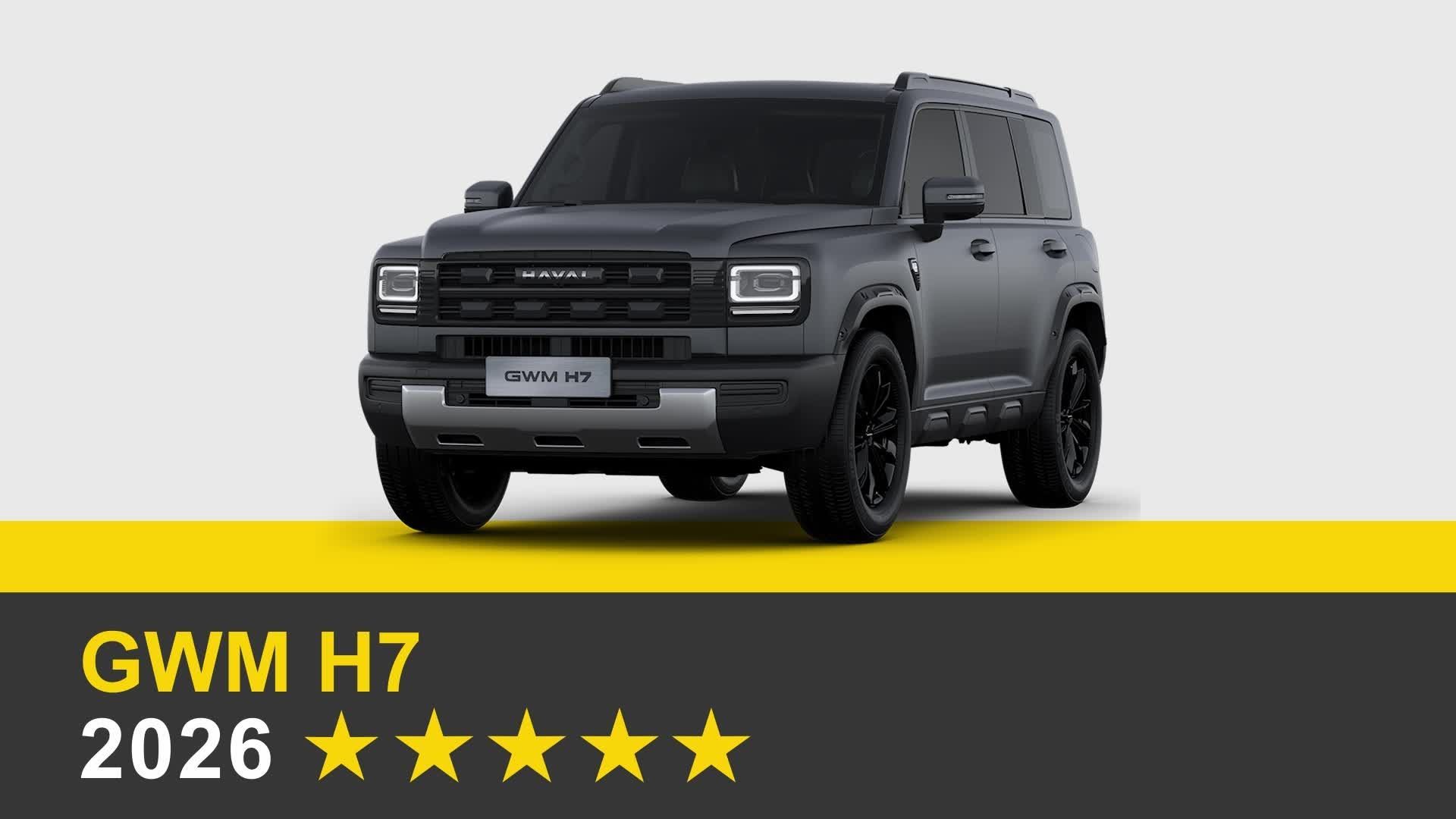
GWM H7
Car Safety Rating 2026 – 5 stars
Verdict:
The GWM H7’s robust and consistent performance across the four stages of safety secures it a 5-star rating, demonstrating excellent all-round protection.
Safe Driving
The GWM H7 recognises seatbelt mis-use, such as a belt worn behind the body, and recognises the presence of all rear seat occupants. There is no recognition of occupants sitting ‘out of position’, with their feet on the dashboard, for example, but occupant stature is correctly recognised, allowing the restraint system to be adjusted appropriately. The GWM H7 is equipped with Child Presence Detection, which issues a warning if a child has been left unattended in the car. The driver monitoring system identifies driver fatigue and various types of distraction. The H7 makes excellent use of manual controls for primary driving controls and also scores well for comfort and infotainment. The speed assistance system of the GWM H7 proved very effective. In a test drive of around 2000 km through Spain, Portugal and France, the system correctly identified the limit in 71 percent of cases, representing 92 percent of the distance covered. The car scored well in an evaluation of its adaptive cruise control system, reacting robustly to cars and motorcyclists and scoring full points in its response to vulnerable road users.
Crash Avoidance
The GWM H7 is equipped with all of the latest crash avoidance technologies, and generally scores well for all of them, including the challenging crossing and turning scenarios. The H7 scores full points for driver acceptance of its lane support system, adapting the sensitivity based on the alertness of the driver. The car protects against ‘dooring’, where a door is opened into the path of a cyclist approaching from behind.
Crash Protection
In the frontal offset test, protection was good for all critical body areas with the exception of the driver’s feet and ankles, protection of which was rated as marginal on the basis of rearward pedal movement. Additional data and validated computer modelling demonstrated good or adequate protection in various combinations of test configuration and occupant stature. Analysis of the deceleration of the impact trolley during the test, and analysis of the deformable barrier after the test, revealed that the GWM H7 would be a moderately benign impact partner in a frontal collision. In the full-width frontal test, protection of the chest was rated as marginal for the rear passenger, based on dummy measurements of compression, but protection was otherwise good or adequate. In the side barrier test and the more severe side pole impact, protection was good for all occupants. The GWM H7 has a centre airbag to protect against occupant-to-occupant injuries in a side impact. The airbag performed well in Euro NCAP’s test, with good protection of the front seat occupants’ heads. Protection of vulnerable road users was mixed: generally good or adequate for the head of a struck pedestrian or cyclist; good at all test points for the femur, but weak at several test locations for the pelvis.
Post Crash
The GWM H7 scored very well in this part of the assessment. Third Party Service (TPS) eCall is not provided but, in the event of a crash, the advanced eCall system provides detailed information about the car's occupants and the type of impact sustained by the car. The GWM H7 also scored well for its provisions for quick and safe extrication by first responders.
For a detailed breakdown of scores and assessment results across all four stages of safety, see the full Euro NCAP datasheet.