
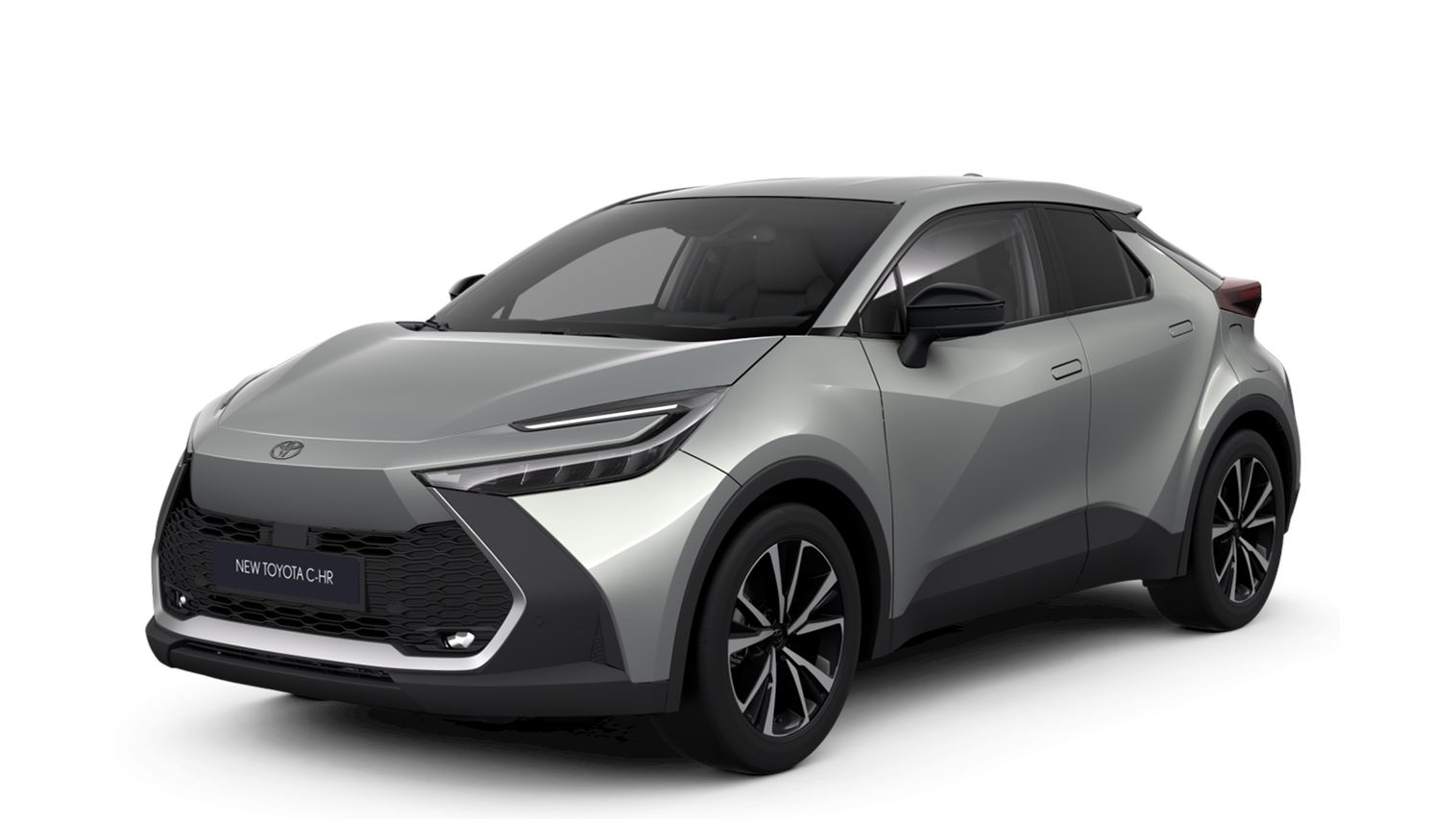
Toyota C-HR
2.0 Teamplayer plug-in hybrid FWD CVT
Sustainability Rating: 4 stars
Our verdict:
Toyota offers the famous C-HR as a plug-in hybrid, and the version tested here is the more powerful 164 kW variant. The car has an empty mass of 1,658 kg and a 13.6 kWh battery, which allows it to travel 66 km in pure electric mode (confirmed by Green NCAP measurements). The available electric range results in approximately equal shares of combustion and electric driving mode in the sustainability assessment, meaning that the benefits of the electric mode are limited. The real-world environmental impact of the vehicle depends on the user's behaviour, driving conditions and recharging frequency. Green NCAP strongly recommends consumers to start their trips with a fully charged battery and to recharge frequently.
- Performs adequately under standard conditions but records elevated particle, hydrocarbon, and CO emissions in demanding cold-start and high-load tests. Loses points due to aggressive accelerator calibration and limited electric range.
- Delivers low electricity consumption and reasonable real-world fuel economy, despite average hybrid-mode efficiency. Records 13.6 kWh/100 km on the on-road test, but requires petrol assistance in both winter testing and longer real-world driving.
- Achieves a moderate GHG result due to a limited electric driving share and relatively high fuel-related emissions. Accumulates 172 g CO2-eq./km of life cycle emissions, with direct combustion emissions contributing a significant share.
Driving Experience
Our comments:
- Green NCAP's real world consumption estimations are based on measured results corrected with factors addressing real-world behaviour. The C-HR's results are ægood' in the warm weather scenarios and in the empty-battery cold winter driving. However, as it was not possible to complete the Cold Winter test in electric mode, the mark received for this case is æpoor', which consumers should bear in mind if their usage case includes frequent cold winter driving. The pure electric range of 65 km is sufficient for an æadequate' note, although the cold winter range gives a æpoor'. Here, the combustion engine starts immediately, and the electric powertrain takes over just after sufficient temperatures have been reached in cabin and components. It is disappointing to see the combustion engine being activated to provide heat. The board computer readings are accurate.
- The C-HR PHEV cabin heating performance with fully charged battery is impressive, as the vehicle heats up very quickly - also in the rear footwell. The car is equipped with a heat pump and utilizes a smart strategy to allocate heat only to occupied passenger seats. In the insulation test, the cabin temperature dropped by only around 4.4°C after being left locked at -7°C for 30 min - a remarkable result. This means that the heat is well maintained inside the car.
See datasheet for more details.