
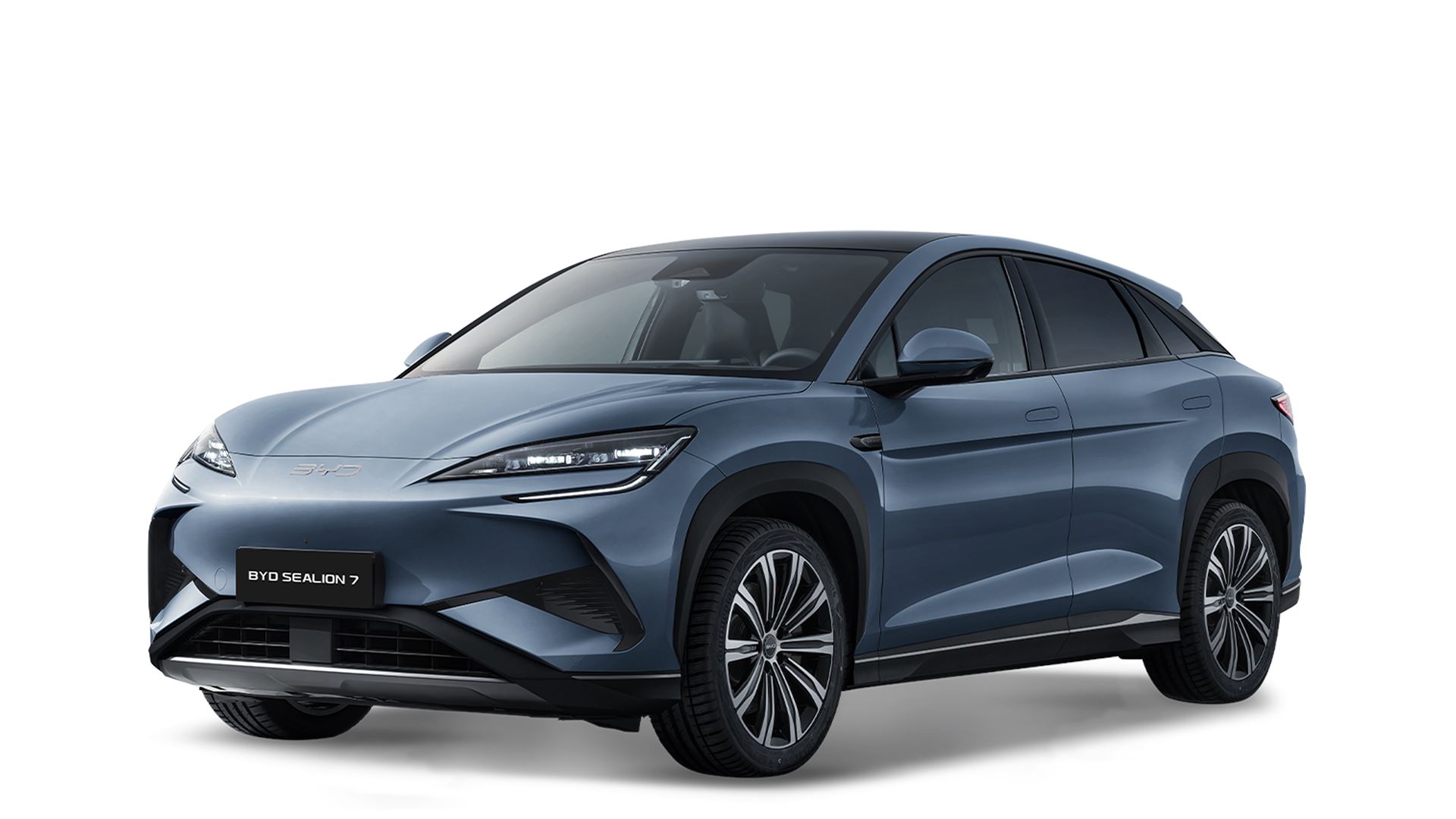
BYD Sealion 7
Comfort electric RWD automatic
Sustainability Rating: 4½ stars
Our verdict:
Update July 2026: BYD provided detailed data for its vehicle post-publication which was then integrated retro-actively. Overall sustainable results increased from a 4-star rating (73% average score) to 4½ stars (81% average score). The vehicle's greenhouse gas index increased from 7.2 to 9.6.
The BYD Sealion is a large SUV with a kerb weight of 2.2 tonnes and a 82.5 kWh battery, which makes its sustainability score a creditable result for a vehicle of this type. It convinces with reasonable consumption values and well balanced electric powertrain.
- The Sealion 7 eliminates exhaust emissions completely and gains points for limiting tyre abrasion through smooth acceleration, but is limited by its high mass and rear toe angle. It recovers brake energy very efficiently and thus minimizes brake abrasion. Some points are lost due to pollutant LCA for production and energy supply.
- The consumption values measured in lab are 19.9-31.3 kWh/100 km depending on the conditions. The Cold Winter tests performance is good and the real-world mixed drive used 21.45 kWh/100 km. The total life cycle primary energy demand is calculated at 82.4 kWh/100 km, including all LCA phases.
- The electric car emits no direct GHGs and production and energy supply dominate its climate impact. The total calculated LCA greenhouse gas emissions sum up to 163.5 g CO2-eq./km, earning the Sealion a score of 7.2/10 in the GHG part of the assessment.
Driving Experience
Our comments:
The sealion 7 is rated as 'adequate' in all three sections of the Driving Experience assessment, demonstrating a good balance between consumption, range and functionalities.
- Green NCAP's estimation of the real-world consumption values results in a mixed picture of 'poor' and 'adequate' evaluations. While all estimated warm weather scenarios suffer due to relatively high consumption values, the cold weather energy demand is mainly in the adequate range, which suggests efficient thermal management. Thanks to the big battery, the Sealion earns a total 'good' mark for driving range, again mostly benefiting from its cold temperatures efficiency. However, BYD could easily improve the accuracy of the board computer consumption display, the readings of which strongly deviate form the measured figures.
- A significant driving range can be achieved in cold winter conditions, if the vehicle can be pre-conditioned before the trip while being plugged to the charger. The cabin heat-up performance of the Sealion 7 is excellent, providing high thermal comfort very quickly. Even the rear footwell is not neglected and less than 300 seconds are needed to reach 16C. In the insulation test at ambient -7°C, the cabin lost 6°C after 30 minutes a result evaluated as adequate. The vehicle's standard equipment with a number of efficient and thermal comfort enhancing functions is impressive.
- Although the tested car reached the declared maximum charging power of 150 kW in the beginning of the recharge, the measured fast charging time (10-80% SoC) was about 8 minutes longer than the officially declared 32 minutes and resulted in a poor note. With 85.3%, the 11 kW home charging grid-to-battery-output efficiency is slightly below the industry average, yet seen as adequate and similar to the values measured for other BYD vehicles previously tested by Green NCAP. As with many other BYD's, the Sealion also offers the possibility to charge external electric devices. The vehicle-to-load function allows the connection of consumers of up to 3.3 kW power and helps reach an 'adequate' evaluation in this part of the assessment.
See datasheet for more details.
Update January 2026 - Green NCAP awarded the 2025 Category Winner Large SUV (Electric) to BYD SEALION 7
Learn more about the Category Winners ▶ Green NCAP names top Category Winners in sustainability for 2025